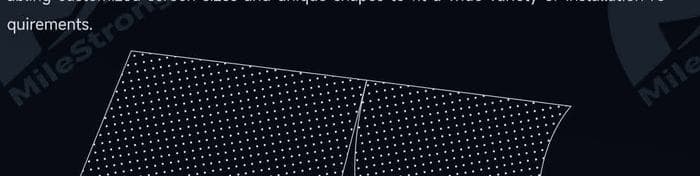
Cuttable and joinable
Modules can be cut and butted edge to edge, following the real shape of your window: horizontal band, column, corner, curve.
Two millimetres thick, bonded to the inside of your glass. Daylight still comes through, passers-by still see inside — and your message plays in full colour right in the middle of the window.
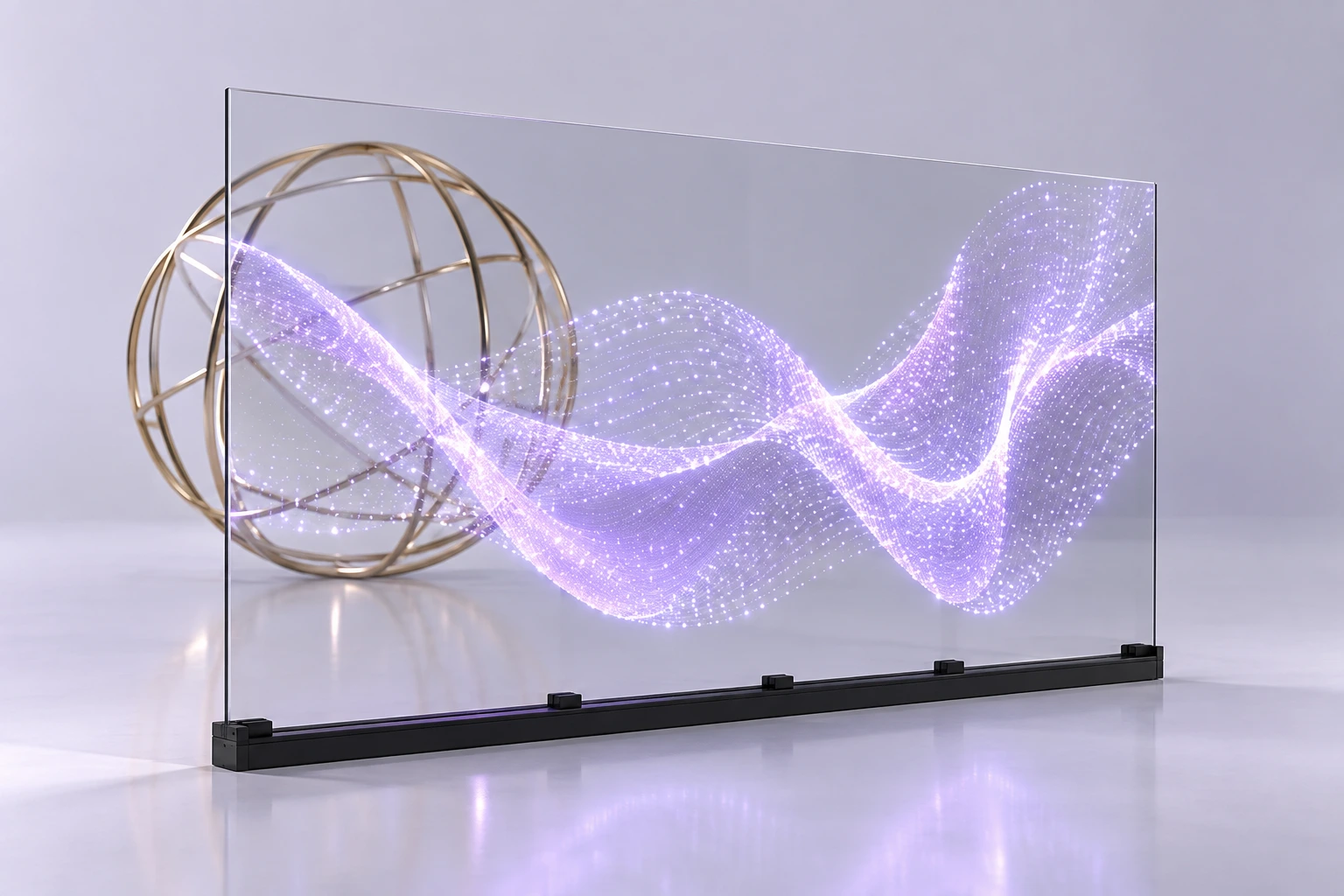
Format illustration. Finishes vary by model.
The crystal film is not a panel placed behind the window: it is an LED circuit embedded in a flexible film that is bonded to the glass, like window graphics. Switched off, it disappears. Switched on, it becomes a large-format video screen.
The tracks feeding the LEDs are a few tenths of a millimetre wide. A metre from the glass the eye sees only a faint grid; from the sidewalk there is nothing but an ordinary window. That is what separates LED film from an opaque panel: you don't close off your storefront in order to advertise on it.
2 mm thick, 1 kg for a P4 module and 1.3 kg for the others. No meaningful load on the frame, no rails, no floor-mounted structure.
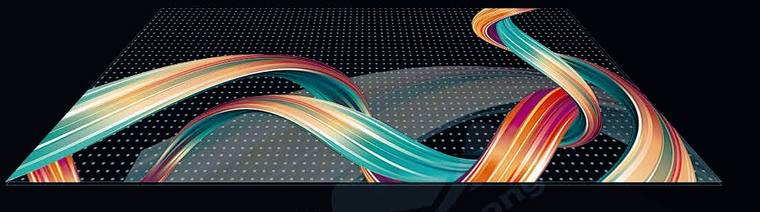
The gap between two LEDs. Tight, the image is sharp but the window darkens slightly. Wide, the window stays almost bare but you need distance to read it. Pick a pitch below.
Reading distance: from 6 m. Wide windows with an open sidewalk. The 4,000-nit version handles full sun exposure.
Modules can be cut and butted edge to edge, following the real shape of your window: horizontal band, column, corner, curve.
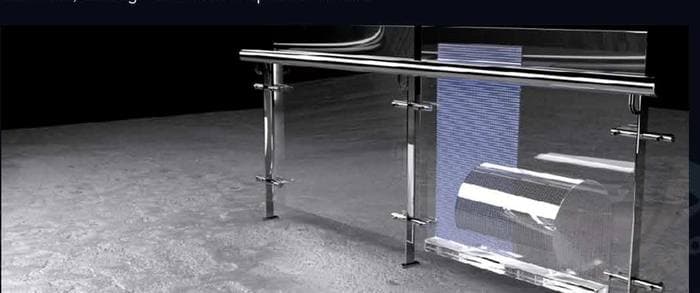
No steel structure, no drilling. The film is bonded to the glass, then power and signal are connected. A standard storefront is fitted in a day.
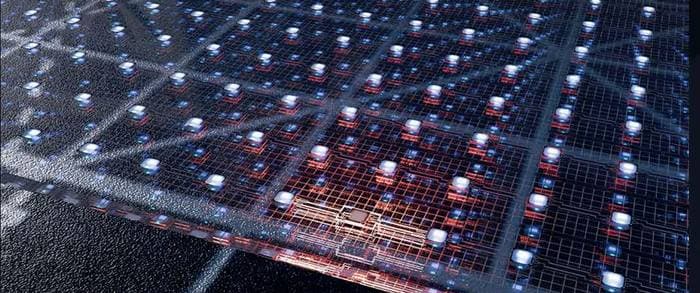
Automatic playback resume after a power cut, with in-house power and drive systems. Built to run 24/7 for over 100,000 hours.
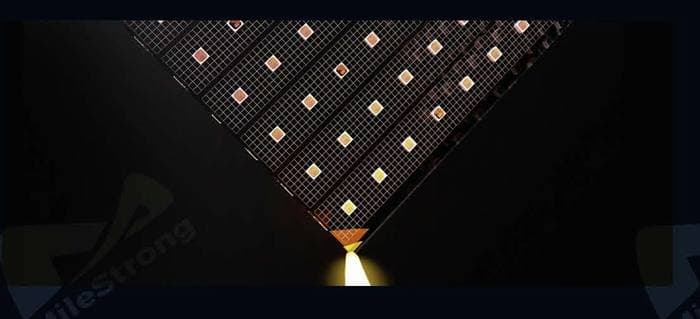
Materials meeting the V1 flame-retardant rating — often required in public buildings, shopping centres and hotel lobbies.
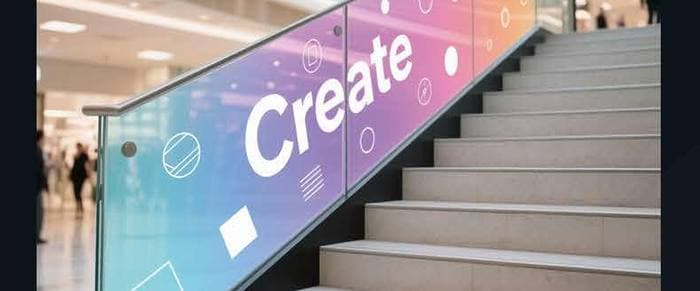
A 3,840 Hz refresh rate and 16-bit depth keep the image stable and flicker-free, even on phone video, and readable at an angle from the sidewalk.
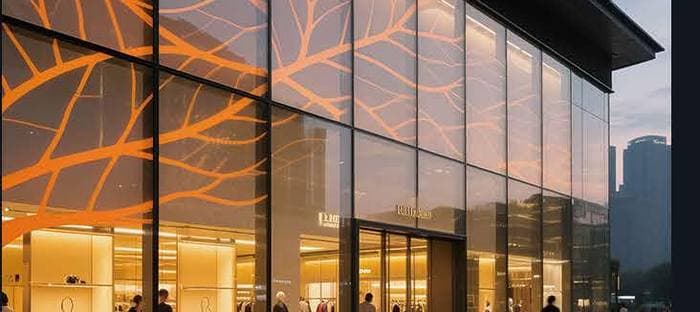
The substrate resists sunlight and keeps its clarity for at least 5 years, including on a south-facing window.
Installation is done from inside the shop. Your glass is not removed, drilled or replaced.
Usable dimensions, viewing distance, orientation and sun exposure. This survey determines the pixel pitch and the brightness.
The inner face is degreased. Any dust trapped under the adhesive stays visible, so this is done with the shop closed.
The film is applied module by module, edge to edge. The adhesive keeps curing for several days and gains strength.
100–240 V connection, controller hook-up, start-up and loading of your first visuals.
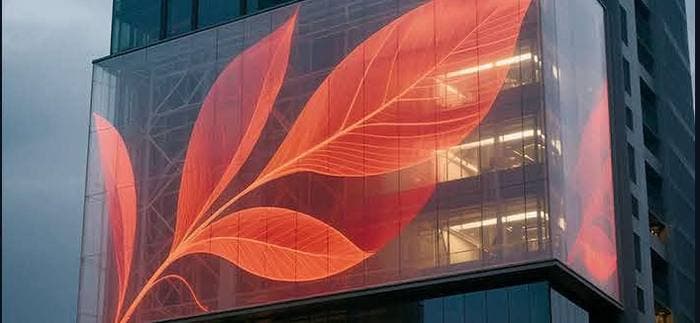
Large glazed building surfaces, showrooms, dealerships. A wide pitch is enough: it is seen from afar and the façade stays transparent.
Balustrades, railings, glass partitions. A surface you could not use becomes a display or advertising space.
Daily menu, offers, opening hours, seasonal mood. The message changes in seconds, with no adhesive to reprint.
The whole range shares the same electronics. Only the pixel pitch, module size and brightness change.
| Specification | P4 | P5 | P6.25 | P8 | P10 | P15 | P20 |
|---|---|---|---|---|---|---|---|
| Pixel pitch (mm) | 4 | 5 | 6,25 | 8 | 10 | 15 | 20 |
| Module W×H (mm) | 240×1000 | 320×1000 | 400×1000 | 400×1000 | 400×1000 | 390×990 | 1000×400 |
| LED type | 1313 | 1313 | 1313 / 2121 | 1313 / 2121 | 1313 / 2121 | 2121 | 2121 |
| Brightness (cd/m²) | 2 000 | 2 500 | 2 000 / 4 000 | 2 000 / 4 000 | 2 000 / 4 000 | 3 000 | 3 000 |
| Pixel composition | 1R1G1B | 1R1G1B | 1R1G1B | 1R1G1B | 1R1G1B | 1R1G1B | 1R1G1B |
| Module resolution | 250×60 | 200×64 | 160×64 | 125×50 | 100×40 | 66×26 | 50×20 |
| Density (pixels/m²) | 62 500 | 40 000 | 25 600 | 15 625 | 10 000 | 4 356 | 2 500 |
| Transparency rate | 90 % | 91 % | 92 % | 92 % | 94 % | 94 % | 95 % |
| Module weight (kg) | 1 | 1,3 | 1,3 | 1,3 | 1,3 | 1,3 | 1,3 |
| Viewing angle (H/V) | 160° / 160° | ||||||
| Grayscale | 16-bit | ||||||
| Refresh rate | 3,840 Hz | ||||||
| Input voltage | 100–240 V AC, 50–60 Hz | ||||||
| Peak power consumption | 600 W/m² | ||||||
| Average power consumption | 200 W/m² | ||||||
| Operating conditions | -10 °C to 60 °C · 10% to 90% relative humidity | ||||||
| Drive mode | Static | ||||||
| Control system | Novastar / Colorlight | ||||||
| Thickness | 2 mm | ||||||
| Fire rating | V1 (flame-retardant) | ||||||
| Service life | 24/7 operation · ≥ 100,000 hours | ||||||
Wide table: swipe sideways to see every column.
Indicative values. Final specifications depend on the model selected and on the contract. The exact screen format is calculated to measure from your window's dimensions.
Yes. Depending on the model, 90 to 95% of the surface stays transparent. Switched off the film is barely noticeable; switched on, the image overlays the window without hiding it. That is the difference from a conventional screen placed in a storefront, which blocks the view entirely.
A simple rule: the minimum viewing distance in metres roughly matches the pixel pitch in millimetres. A P4 reads from 4 metres, a P20 needs around twenty. For a pedestrian-street window, P4 to P8 is the usual starting point; for a façade seen from a junction, P10 to P20.
Yes. The brightest versions reach 4,000 nits, far above an indoor television. The film is fitted on the inside and displays outwards, including on a south-facing window.
200 W/m² on average, 600 W/m² at peak. For 2 m² of film running ten hours a day, expect roughly 4 kWh per day in average use. Bright content and white backgrounds draw noticeably more than dark visuals.
Through the Novastar or Colorlight controller supplied with the screen: from a computer on site, or remotely over the network. You play images, video and scrolling text, and schedule time slots.
The film is flexible and the modules can be cut. Curved windows, corners and non-rectangular shapes are handled case by case — send us photos and dimensions and we'll tell you what is feasible.
Send us a photo of your storefront and its dimensions — we'll come back with the recommended pixel pitch and a quote.